In export injection mold projects, buyers usually focus first on mold price, lead time, cavity count, and whether production can launch smoothly. Those factors matter—but one of the biggest drivers of long-term mold performance is often decided much earlier: mold steel selection.
Mold steel is not just the material used to build the tool. It directly affects wear resistance, dimensional stability, polishing quality, corrosion resistance, maintenance frequency, and total service life.
For export molds, this matters even more. Once the mold is shipped overseas, it may need to run hundreds of thousands or even millions of cycles. If problems appear later, repair time, downtime, logistics cost, and communication delays all become more expensive.
Many molds perform well during trial runs, then develop flash, unstable dimensions, poor surface finish, or frequent maintenance needs during mass production. In many cases, the root cause traces back to steel selection.
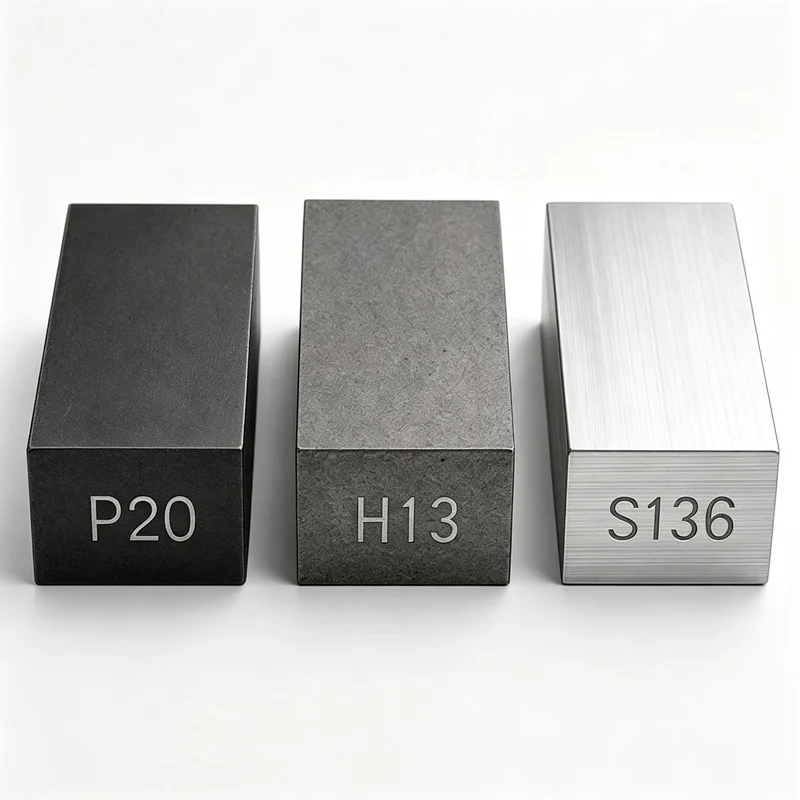
Understanding the differences between P20, H13, S136, and NAK80 is not about memorizing material names—it is about making a smarter production investment.
Why Steel Selection Matters More for Export Molds
The biggest difference between export molds and short-term domestic projects is the need for long-term production stability.
After delivery, the mold is far from the original manufacturer. If wear, rust, or precision loss occurs, recovery is slower and more costly. In some cases, it can disrupt the customer’s entire production schedule.
Examples:
- Glass-filled resins: Low wear resistance can accelerate cavity erosion and increase flash.
- PVC or flame-retardant materials: Poor corrosion resistance may lead to rust or surface damage.
- High-gloss cosmetic parts: Weak polishability can reduce final appearance quality.
The right steel choice protects not only tool life, but also day-to-day production reliability.
P20: Reliable and Cost-Effective
P20 is one of the most widely used pre-hardened mold steels in the injection molding industry.
Its biggest advantage is balance: reasonable cost, efficient machining, and dependable service life.
Because P20 is commonly supplied in a pre-hardened condition, mold makers can machine it directly without additional heat treatment. This shortens lead time and reduces distortion risk.
P20 is a strong fit for:
- Household products
- Consumer electronics accessories
- Standard structural plastic parts
- PP, ABS, PE, and other common resins
- Medium-volume production programs
If the application is straightforward, P20 is often the practical answer.
However, for ultra-high volume production, aggressive materials, mirror finishes, or high corrosion demands, upgraded steel grades may be the better choice.
H13: Built for Heavy-Duty Production
H13 is commonly selected for more demanding molding environments.
It offers strong wear resistance, good toughness, and excellent resistance to thermal fatigue. That makes it suitable for long production runs and higher mechanical stress.
When molding materials contain glass fiber, mineral fillers, or other abrasive additives, cavity surfaces experience continuous wear. In these cases, H13 usually outperforms general-purpose steels.
Best applications include:
- High-cavity molds
- Engineering plastic parts
- Large-volume orders
- Tight dimensional tolerance programs
- Long-life tooling strategies
H13 usually costs more and requires more processing effort than P20, so it makes the most sense when the project life justifies the investment.
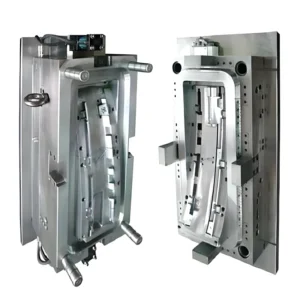
S136: Corrosion Resistance and Clean Surface Performance
S136 is a premium stainless mold steel widely used where corrosion resistance and surface quality are critical.
If the resin is PVC, flame-retardant, or processed in humid environments, conventional steels are more vulnerable to rust. S136 significantly reduces that risk.
It also offers excellent polishability, making it ideal for products where visual quality matters.
Common uses include:
- Transparent covers
- Optical parts
- Medical housings
- Food-contact components
- High-cleanliness molded products
Although the initial tool cost is higher, S136 often lowers maintenance and quality risk over the life of the mold.
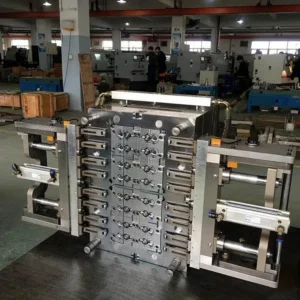
NAK80: Excellent for Cosmetic Parts
NAK80 is a popular choice for appearance-driven products.
It is known for strong polishability, good texture reproduction, and stable machining performance. That makes it especially useful for products where look and feel influence market value.
Typical applications:
- Consumer electronics housings
- Beauty packaging
- Appliance panels
- Branded consumer products
For these programs, gloss consistency, fine texture, and clean detail are not optional—they are part of the product itself.
NAK80 is not usually the first choice for highly abrasive materials or maximum wear-life applications. Its strength is cosmetic quality.
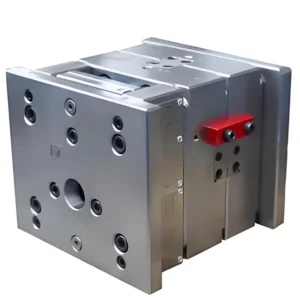
How to Choose the Right Mold Steel
A professional material decision is not “Which steel is best?” It is “Which steel is best for this project?”
Use this logic:
- P20 – Best for balanced cost, moderate volume, and standard resins
- H13 – Best for long runs, abrasive materials, and higher wear demand
- S136 – Best for corrosive resins, transparent parts, medical, and food-grade projects
- NAK80 – Best for premium surface finish and cosmetic components
One more point: do not evaluate a mold only by purchase price.
A mold is a production asset. Maintenance cost, downtime risk, reject rate, and tool longevity should all be part of the ROI calculation.
Final Thoughts
P20, H13, S136, and NAK80 are all proven mold steels—but they solve different problems.
- P20 focuses on value and efficiency
- H13 supports heavy-duty long-term production
- S136 excels in corrosion resistance and clean-surface applications
- NAK80 stands out in cosmetic molding projects
The most professional decision is not choosing the most expensive steel or the most common one. It is choosing the steel that matches your product, process, and business goals.
For custom tooling projects, manufacturers like toolingsun can help evaluate part geometry, resin type, volume targets, and quality requirements to recommend a more effective mold steel strategy.